


By Bart Barry-
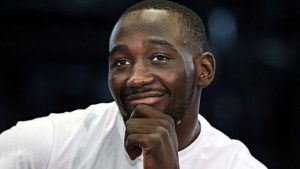
Saturday in Lincoln the fighting pride of Nebraska, Terence “Bud” Crawford, unmanned and unbellied Namibian Julius Indongo on ESPN to become the first unified champion of the junior welterweight division in . . . who knows, maybe the history of that young division. Most importantly, Crawford did it with aggression and form, beating the sauce out his man.
This Saturday Floyd “Money” Mayweather enters the silly season of his career with a special-attraction-championship-exhibition match against an Irish MMA champion named Conor McGregor.
What these events have in common is the calendar. Let us not waste that.
Unifying titles in this era the way Crawford just did is, conversely, less likely and less admired. If it’s less admired it’s a consequence of the saturation grift sanctioning bodies perpetrated on the sport with promoters’ and networks’ assistance decades ago – the belts mean nothing, so he who collects them is the king of nothing. That may well be aficionados’ reality but it’s not one common among prizefighters. They know the difference between meaningful belts and less meaningful belts because they suffer to come by them and keep a precise accounting thereby.
The odder part of the unification labyrinth, though, is the logistical difficulty of this generally thankless feat. It’s not enough to imply the sanctioning bodies are indifferent to sharing a champion with one another – they’re fully and actively against the ruse. Once a man has unified all the belts he is larger than their sum, and many multiples larger than any one of them, and boxing’s major crime families move swiftly against him; each sanctioning body has a unique mandatory challenger and invariably a unique mandatory challenger behind him, and so to keep his unified titles unified a unified champion must fight eight times in about 11 months against men nobody has heard of and far fewer would pay to see.
The sanctioning bodies are collectors, not distributors, they are sponsored, not sponsors – they expect their titlists to take whatever prestige accrues to those titles and vend like hell to pass a percentage of winnings their sanctioners’ way. One wrong move, too, one misplaced obscenity, one improper flirtation with an unsanctioned challenger or promoter, and the stripping commences. If it be nigh impossible to unify titles, it is irrational to keep them that way.
Terence Crawford knows this and knows too what logistical gymnastics were required to get to Saturday’s match and knows still better there ain’t no money in satisfying sanctioners’ requirements one moment after unifying. He owns the junior welterweight division just seven matches after joining the junior welterweight division (Gennady Golovkin, conversely, has been trying to unify the middleweight division since beating Nilson Julio Tapia [14-2-1] in 2010). Crawford benefits greatly from a promoter that knows what it’s doing, a promoter that has been here oftentimes before, knows which levers work and where to set the fulcrum and, perhaps most importantly, doesn’t lowball the owners of what titles its champion seeks to unify.
Top Rank likely overpaid some of the opponents Crawford whupped these last two years, but it now has a man near to being a household name as boxing gets, who is also a regional ticketseller, and after an abominable showing on pay-per-view, something of a chastened economical realist. Top Rank continues increasing the quality of its fighters’ opponents until its fighters lose and thereby assert a quest for greatness that goes: I took my talent far as humanly possible.
Nobody knew this better than Floyd Mayweather; had Mayweather wished to be “TBE” Floyd would’ve stayed with Top Rank and, like every realistic candidate for the “TBE” title, Floyd eventually would have lost. Floyd didn’t like Top Rank’s compensation algorithm in the least – way way too much risk for way way too little reward – and followed his heart to great wealth but now enters a carnival stage in his career to silence what angsty voices nag a talented man who knows he didn’t take his talent to its limits. A dangerous space for the man because if Saturday goes as expected, what comes next?
Nobody who believes Floyd squandered his talent in part on handicapping every match to near bloodlessness – swerving Kostya Tszyu and Antonio Margarito completely; swerving prime versions of Manny Pacquiao and Miguel Cotto; fighting Juan Manuel Marquez three weightclasses high, etc. – will suddenly reform his opinion after watching Money safely avoid an MMA dude for 36 minutes. Since he can’t stay retired, obviously, what does Floyd do next to make himself feel great – fight the Brothers Charlo at the same time? throw hands with Adrien Broner from a stripper pole?
(Having never seen a minute of a Conor McGregor fight but having trained at a predominately MMA gym for years and boxed some of the lads, I assume the chalk is right and McGregor hasn’t a prayer, with one caveat: How many folks who are positive Floyd will win were just as positive Hillary would win, and of those same folks that say “predictions in boxing and politics are completely different!” how many wouldn’t’ve used the exact same logic if the events’ chronology were reversed? The trend: Folks who aren’t always right but are never uncertain.)
The calendar juxtaposes Floyd and Terence for us, and the comparison may well be apt. Floyd was 35 fights in his career when he got off the Top Rank track, buying his way out of a promotional contract that guaranteed some unsavory combination of Margarito and Cotto, to fight instead Carlos Baldomir. Crawford is 32 fights in a career that did not begin auspiciously as Mayweather’s but is becoming increasingly dominant. He has not peaked yet as a fighter or as an attraction. He hasn’t Floyd’s upside as a fighter or an attraction.
But Floyd never put more than 75-percent of his talent on the line and Crawford will have to if he stays with Top Rank. The question then becomes: Is 100-percent of Terence Crawford’s talent greater than 75-percent of Floyd Mayweather’s? If so, many millions of Americans more are about to watch Crawford’s prime happen on ESPN than ever saw Floyd’s on HBO, and we know how finicky be public opinion and what polling writes history. Poor Floyd.
Bart Barry can be reached via Twitter @bartbarry