


By Bart Barry–
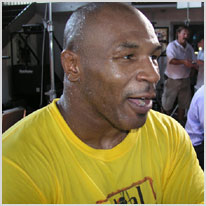
SAN ANTONIO – This column was supposed to be about a live theatrical performance by Mike Tyson, a review of sorts from ringside by a writer who lives above the historic Majestic Theatre, downtown, and attends most Broadway-musical productions that visit. “Mike Tyson: Undisputed Truth” was scheduled for Saturday night in the Lila Cockrell Theatre, a 2,000-seat venue attached to this city’s large and expanding convention center. A boxing-trainer friend would stop by, and we would amble 10 minutes along the River Walk to the edge of HemisFair Park, home of the Tower of the Americas and the 1968 World’s Fair.
Instead, Thursday night brought an announcement there would be no Mike Tyson. Sluggish ticket sales were cited. It’s no wonder. There aren’t five of us in this city who write regularly about the sport, and few of us knew about Tyson’s performance till Monday evening at Cowboys Dancehall, where Leija-Battah Promotions presented a main event that would prove Rocky Juarez’s last – and yes, these things share a thread.
Between Monday’s card, which Tyson did not attend, and Saturday’s scheduled performance, the excellent and deservedly celebrated musical “Chicago” began a six-show run at Majestic, with the uniquely talented Mexican actress Bianca Marroquin shining in the role of Roxie Hart. To watch Marroquin act and sing and dance, and somehow project subtle gestures hundreds of feet – and this, along with the live nature of stage acting, is what makes it a craft of such greater depth and refinement than anything that happens on a movie set’s 41st take before the tightly cropped frame of an HD camera – was to be blessed with an entirely too-infrequent reminder about talent: It is inarguable.
If ever you find yourself preceding an assertion of some artist’s talent with the words “really” or “actually” you should treat those adverbs as alarms: You don’t mean what you’re about to say, you are not convinced, and you hope to argue your way into a faith in that artist’s talent while stiffening that hope into a conviction by way of others’ affirmation.
On a stage filled with touring professionals, most in the same costume, Marroquin was the figure one’s eyes immediately found, often without seeking her. The foundation of her stage presence – and this is what acting shares with all other arts – happened in the layers with which she entertained. This is something that transcends mere range, which is a flat spectrum that delineates how many distinct characters an actor can portray; Marroquin’s presence was created by the number of emotions she portrayed at the very same time. Much of that is excellent writing, even more of it is a character, Roxie Hart, about to celebrate her 40th year of performance – and what richness the geology of creativity produces in a character subjected to time and pressure by talented actors’ interpretations of her – but the execution of a transcendent performance, finally, belongs to the stage actor alone, an artist talented and textured enough to invent pleasant surprises between scripted lines.
These notes about talent and texture and transcendence refer directly backwards to Houstonian Rocky Juarez, who announced his retirement immediately after losing lopsidedly Monday night on the northeastern outskirts of this city. It is rare, anymore, almost miraculous, unfortunately, that a prizefighter, or any professional athlete, can summarize his career coherently, but Rocky did it over the PA system, Monday, closing a short goodbye speech thusly:
“I had a great run. And I tried, I tried. I love you guys. Thank you.”
“And I tried, I tried” – those words capture perfectly the often-frustrating arc of Juarez’s run as a world-title challenger. In 2005, Juarez lost a very close decision to Humberto Soto for an interim world title. Nine months later, he beat an underprepared Marco Antonio Barrera, only to hear a questionable draw decision announced, only to see it later changed by the California State Athletic Commission to a split-decision for Barrera. Four months after that, Juarez was undressed by Barrera in their rematch. Fourteen months later, Juarez went to Tucson to challenge the master Juan Manuel Marquez for the title Marquez took from Barrera, and Marquez beat him soundly. Fifteen months after that, Juarez drew with Chris John before losing another rematch decision seven months later. A three-year losing streak ensued until Golden Boy Promotions brought Juarez to this city late in 2012 to lose to Antonio Escalante – but Juarez ruined Escalante in eight rounds.
Juarez did not quite have talent enough for a transcendent performance; his silver medal at the 2000 Olympic Games played as his career’s metaphor well as his farewell address captured his profoundly honest efforts as a prizefighter.
Mike Tyson had transcendent talent and only partially squandered it with the many poor choices he made during his adolescence, prizefighting career and retirement. His cancellation of a performance in San Antonio will not be tallied among these – it’s doubtful Tyson even knew he was supposed to be in Texas last week – but it will work as a tidy reminder how ephemeral comebacks in boxing are.
In 2013, HBO put the full might of its marketing programs behind Tyson’s next comeback, stage performer, and boxing writers dutifully wrote ad copy for “Mike Tyson: Undisputed Truth” in time for HBO’s presentation of director Spike Lee’s cinematic adaptation of Tyson’s soliloquy. Tyson, too, was a boxing promoter, we learned, and bringing his charismatic self wrapped in a feelgood bow to that enterprise.
Now it is 2015, and Mike Tyson just cancelled a show because the public has lost interest.
Bart Barry can be reached via Twitter @bartbarry